 |
 © ©
|  |
 |
| Vessel Type: | Motorship | Location: | Co. Cork |
| Date of Loss: | 30th November 1954 | Place: | 25 miles off Ballycotton |
| Cause of Loss: | Capsized in heavy storm | Last known position: | 54° 14' North x 07° 30' West |
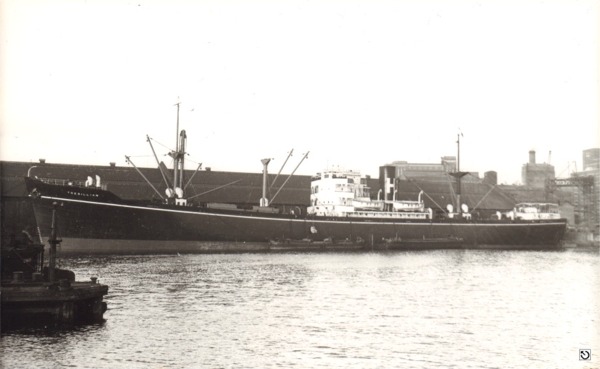
© by kind permission of WSPL
From Christy McHale of the University of Liverpool, - I enclose a brief account of her sinking, taken from Sea Breezes at the time (see below). If she appears to have had rather a lot of changes of ownership in a relatively short life, it’s worth pointing out that these were all internal to the P. & O. group: though the article doesn’t say so, her original owners, the Strick Line (for whom she was built as the "Registan") were also part of the combine. When the article refers to her as ‘a typical Doxford motorship’, it’s perhaps relevant to explain that during the War relatively few ships were custom-built for operating companies, ‘off the peg’ to standard designs by builders being the order of the day. The "Registan" was the 12th to be completed of a class of 16 identical motorships to a Doxford design. For what it’s worth, 7 of the 16 were built for the government (the Ministry of War Transport), three for Strick (the other two being the "Arabistan" and "Floristan"), two for Hain (the "Trevethoe" and "Trevose"), two for the Bank Line of Glasgow, and one each for the Prince Line and the Moor Line, both of Newcastle. The photo shows the "Tresillian" during her time with the Hain Steamship Company (when she moved to P. & O. she looked the same except that the white ‘H’ on her funnel was painted out, making it plain black), in a location that I can’t positively identify, though I’ve a hunch that it’s in the Manchester dock system. |
| Commentary:
Gale Casualties by Stephen Tetlow As November drew to a close, the coasts of Britain and those of her near neighbours were being pounded by heavy seas which caused widespread damage, both at sea and on shore. Lifeboats and salvage tugs were busy, but in general the ships that were in need of assistance were of modern vintage, and give us little of a historical nature. Perhaps the most tragic casualty in this period of heavy weather was the sinking of the P. and O. motor-ship Tresillian (7,373 gross tons), which foundered off the coast of Ireland, with the loss of 24 members of her crew. She was bound from Sorel, P.Q., for Avonmouth and Glasgow with a cargo of grain, and developed a list which caused her to be abandoned. Two ships picked up survivors, the motor tanker Liparus, and the Greenock motorship Ardglen, and other ships that searched for further men included the motorship Parima, of the Royal Mail Lines, the Floristan, of the Strick Line, and the recently completed Brocklebank steamer Maskeliya. The Tresillian was built and engined by Wm. Doxford and Sons, Ltd., Sunderland, being completed in December 1944 as the Registan, for the Strick Line Ltd. She was purchased by the Hain Steamship Co., Ltd., in 1945, and after a short period of trading for them under the name Registan they gave her the name Tresillian. In 1950 she was transferred to the Peninsular and Oriental Steam Navigation Company, which is associated with the Hain Steamship Company. A typical Doxford motorship, she had a capacity of 10,067 tons deadweight, and a speed of 11 knots. In February 1953 she had to put into Ferrol with engine trouble which delayed her for several days, and the following June, while docking at Kobe, en route from London for Yokohama, she ranged alongside a wharf causing some damage to shell plating. Her last voyage had started at Urangan, Queensland, which she left on August 28, and after calling at Suva in September, she proceeded to Canada, and eventually left Sorel for the United Kingdom on November 17. Among the casualties when the Tresillian sank 44 miles from Cork was her master, Capt. W. J. Winter, of Troedyrhiw, Glamorgan. Sea Breezes January 1955 |
By kind permission and © Sea Breezes
| Source Publications: |
| "Irish
Wrecks Database" | by | Roy Stokes & Liam Dowling | |
| Other Sources: |
| - | via email (2008) |
| |
Last update - 02-Apr-2008
| |

A page from "www.irishwrecksonline.net" ©